GPT-6 Astra Features: Complete Guide for Businesses in 2026
Explore next-gen GPT-6 Astra Features. Discover native multimodality, ultra-low latency, and advanced predictive computing.
Introduction
The GPT-6 Astra model marks a massive leap forward.
Experience the next generation of AI with advanced GPT-6 Astra Features.
It blends multimodal processing with near instantaneous reasoning. This
architecture redefines human-computer interaction. It introduces native
multimodality for text, audio, and live video.
The system utilizes advanced predictive computing. It anticipates
user needs and automates complex workflows easily. Furthermore, its ultra-low
latency optimization ensures smooth conversations. Real-time voice interactions
feel completely natural. With enhanced context window capacity, it analyzes
massive datasets effortlessly. These cutting-edge GPT-6 Astra Features
make it the ultimate tool for enterprise productivity.
What
Is GPT-6 Astra?
OpenAI released GPT-6 Astra on
September 3, 2026. It replaces GPT-5.6 Sol as the company's flagship model,
and it targets real business work, not just chat. Astra handles computer use,
coding, and research tasks from start to finish. his guide covers the GPT-6
Astra features that matter most for business teams. You will learn how the
model prices out, what it scores on key benchmarks, and why it carries a new
safety label. Every fact below comes from OpenAI's own launch materials and
independent reporting.
Context Window and Speed: Core GPT-6 Astra Features
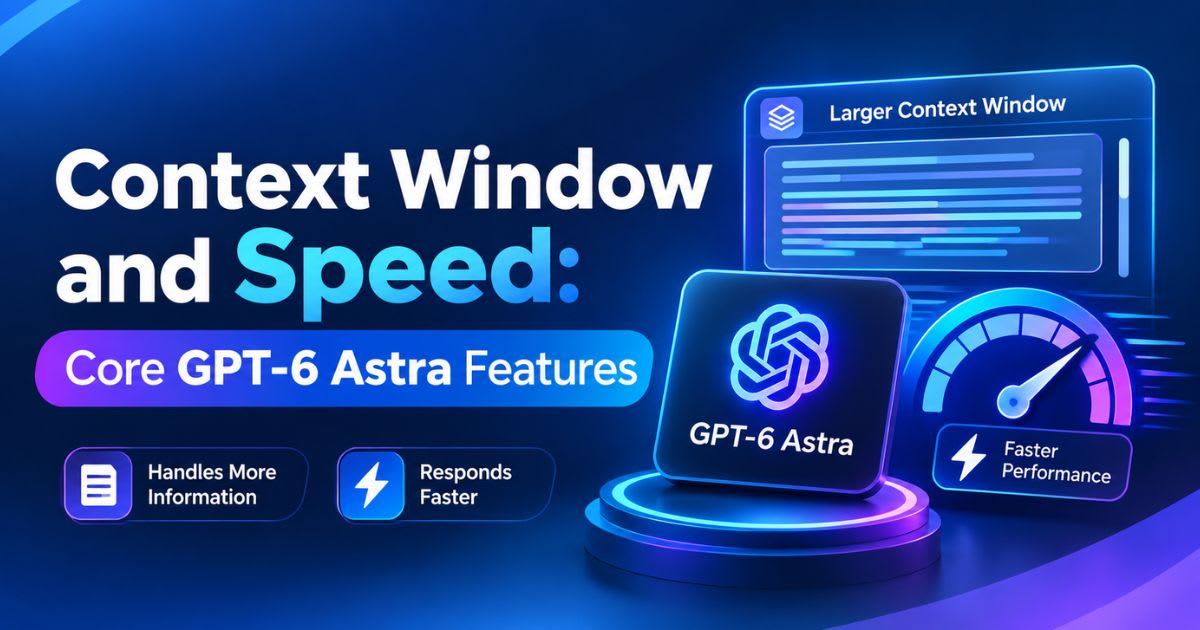
Astra ships with a 1.05 million
token context window and a 128,000 token output limit. That size lets the
model read huge codebases, long contracts, or full research papers in one pass.
It also carries a knowledge cutoff of April 2026, backed by live web search.
Speed matters just as much as size for daily work. On OSWorld 2.0, Astra scores
72.6%, up from 65.7% for GPT-5.6 Sol. Average task time drops from about 75
minutes to 40 minutes, so your team waits less for results.
GPT-6
Astra Features for Computer Use and Business Tasks
Computer use sits at the center of
this release. Astra fills out web forms, updates CRM records, edits
spreadsheets, and works inside tools like Power BI. It also drives specialized
engineering software, including KiCad and FreeCAD, without needing a custom
connector. For coding teams, Codex now keeps searchable notes across long
sessions instead of compressing everything into one summary. This change
preserves details from earlier steps, so debugging stays accurate even
during long, multi-hour agentic workflows across your codebase.
Benchmark
Performance: How Astra Stacks Up
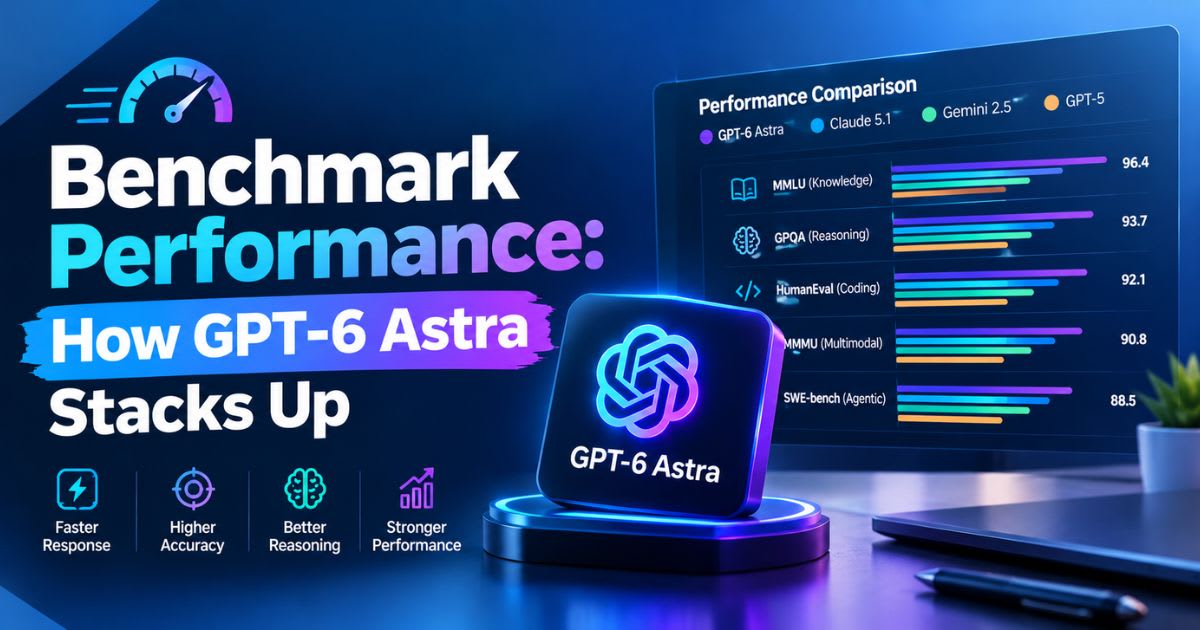
Independent and internal testing
both show sizable gains over the previous generation. OpenAI reports a 99.9%
score on ARC-AGI-3 and roughly 98% on FrontierMath Tier 4, two of the toughest reasoning
benchmarks available today. These scores place Astra ahead of GPT-5.6 Sol across nearly every category.
|
Benchmark |
GPT-6 Astra |
GPT-5.6 Sol |
|
OSWorld 2.0 (computer use) |
72.6% |
65.7% |
|
ARC-AGI-3 |
99.9% |
Lower |
|
ExploitBench (cybersecurity) |
100% |
78.5% |
|
Avg. task time |
~40 min |
~75 min |
These numbers come from OpenAI's
own system card and safety overview, cross-checked against independent
coverage from MarkTechPost and CSO Online.
Astra
vs. GPT-5.6 Sol: What Actually Changed
The jump from GPT-5.6 Sol to Astra
is bigger than a version number. OpenAI's own researchers describe this
training run as their largest to date, built on more than 100,000 GPUs. That
extra scale shows up directly in the capability gains across coding,
computer use, and science. Earlier models often dropped context mid-task, treating
a new instruction as a fresh goal. Astra keeps the original constraints while
it handles side questions, so long multi-step projects stay on track
instead of drifting off course halfway through.
GPT-6 Astra Features for Scientific and Research Work
Beyond office tasks, Astra
supports serious scientific work. OpenAI says the model helped formalize
solutions to math and computer-science problems that had stayed open for a
decade, then verified the logic using machine-checkable proofs called Lean
certificates. For research teams, this pairs scientific reasoning with computer
use. Astra can inspect lab data directly inside specialized software, flag odd
results, and suggest what to test next, cutting down the manual data
analysis that used to eat up a researcher's week.
How
Astra Compares to Other Frontier Models
Astra leads OpenAI's own lineup,
but the wider market keeps moving too. Anthropic reported a 77.9% score for
Claude Fable 5.1 on OSWorld, though it used a different benchmark version and
cautioned against a direct comparison with Astra's 72.6%. Pricing tells a
clearer story. At $10/$50 per million tokens, Astra costs more than earlier
OpenAI models like GPT-5.6 Terra, so match the model to the task complexity
instead of defaulting to the flagship for every request.
Cybersecurity:
The First Model at the "Critical" Threshold
This is one of the most important
GPT-6 Astra features for security-minded businesses. Under OpenAI's Preparedness
Framework, Astra is the first model rated "Critical" for
cybersecurity capability. That means it can find and exploit unknown security
flaws in hardened systems on its own.
What
the Critical Threshold Means for You
A Critical rating triggers extra
deployment restrictions, not open access. OpenAI restricts advanced offensive
features to a vetted program called Daybreak, with a defensive-focused
track named Daybreak Blue rolling out to help security teams patch flaws
faster.
Pricing
and Token Costs for GPT-6 Astra Features
Standard API pricing runs $10.00
per million input tokens and $50.00 per million output tokens. Cached input
tokens cost $1.00 per million, which helps when you reuse the same system
prompts repeatedly. Batch jobs get a 50% discount for non-urgent workloads.
The
Long-Context Surcharge
Requests above 272,000 input
tokens trigger a surcharge on the entire request, not just the extra tokens.
That threshold sits at roughly 26% of the full context window, so plan your prompt
design carefully to avoid it.
|
Request size |
Input rate |
Output rate |
|
Under 272K tokens |
$10.00 / million |
$50.00 / million |
|
Over 272K tokens |
$20.00 / million |
$75.00 / million |
Data
Privacy and Safety Controls for Business
Zero Data Retention is available
for eligible API customers, meaning your prompts and outputs are not
stored after processing. OpenAI also added stricter checkpoint encryption and
expanded monitoring of the model's reasoning steps, called chain of thought, to
catch risky behavior early. Enterprise access is off by default. Workspace
admins must manually enable Astra before employees can use it, giving IT teams
direct control over rollout timing and which departments get access
first.
Enterprise
Rollout: Plans and Variants Explained
OpenAI ships two versions at
launch: the full Astra model and a lighter variant called Astra Pro. Business
and Enterprise customers get both included in existing subscription plans,
without needing a separate contract or a new pricing tier. Astra Pro trades
some depth for speed, which suits shorter, everyday requests. Full Astra fits
harder, longer jobs, so most teams will route routine queries to Astra
Pro and save the full model for complex, multi-step work.
Real
Business Use Cases Emerging Early
Early adopters are testing Astra
across several departments, not just engineering. Reported use cases include:
● Finance
teams reconciling spreadsheets and flagging mismatched entries automatically
●
Support
teams drafting and updating customer records inside CRM software
●
Engineering
teams running overnight code reviews across large repositories
●
Research
teams inspecting lab results directly inside specialized analysis tools
● Operations
teams filling out recurring compliance forms without manual entry
These examples come from early social posts and vendor write-ups
rather than controlled studies, so treat them as directional signals,
not guaranteed outcomes for your own workflow.
How
to Access GPT-6 Astra Today
Access started with a limited
group tied to the Daybreak cybersecurity program. OpenAI is expanding it to
ChatGPT Plus, Pro, Business, and Enterprise plans, plus the OpenAI API and
Amazon Bedrock. Free-tier access has not been announced. Developers can call
the model using the ID gpt-6-astra through the standard OpenAI API endpoint.
Pro, Business, and Enterprise subscribers also receive a lighter variant called
Astra Pro alongside the full release.
Limitations
to Know Before You Deploy
No model is risk-free, and Astra
is no exception. Its Critical cybersecurity rating means OpenAI adds extra
friction on purpose, so some advanced security workflows feel slower or get
blocked outright for most accounts at launch. Coding gains also look modest
next to the computer-use jump. On the DeepSWE benchmark, Astra sits close to
other leading models rather than pulling far ahead, so pick Astra for long-horizon
tasks, not pure code generation speed.
Should
Your Business Use GPT-6 Astra?
Astra fits teams running long,
multi-step automation workflows: document review, spreadsheet cleanup, or
software maintenance. The bigger context window and steadier task memory reduce
the babysitting earlier models needed during long sessions. Weigh the cost
before rolling it out broadly. At $10/$50 per million tokens, Astra costs more
than lighter models built for simple text tasks. Start with a small pilot
project, track real GPT-6 Astra features your team actually uses, and expand
from there.
A
Quick Checklist Before You Start
Use this short list to plan your
first Astra pilot:
●
Pick
one repetitive, multi-step task as your test case
●
Ask
your IT admin to enable Astra for a single workspace first
●
Set
a token budget and watch for the 272,000-token surcharge line
●
Turn
on Zero Data Retention if you handle sensitive client data
●
Review
output on a handful of runs before trusting it fully
Sources
OpenAI, GPT-6 Astra launch
announcement: https://openai.com/index/gpt-6-astra/
OpenAI, Safety overview: GPT-6
Astra: https://openai.com/index/safety-overview-gpt-6-astra/
OpenAI, Path to Astra: https://openai.com/index/path-to-astra/
Related articles
 AI for Business
AI Tools for Small Business That Pay for Themselves
AI tools for small business that pay for themselves fast — real picks for marketing, support, and accounting.
 AI for Business
Best AI Virtual Staging Tools in 2026: Real Estate Guide
Transform empty listings with AI virtual staging. Add photorealistic furniture in seconds to attract buyers and sell homes faster.
 AI for Business
Is It Worth It? GPT-6 Astra Pricing and Plans Revealed
Don't overpay for tokens. See full GPT-6 Astra Pricing, benchmark costs, and smart caching tips to maximize your software ROI now!
New AI tool reviews, in your inbox.
Get new reviews and comparisons in your inbox. No spam, unsubscribe anytime.
Comments (0)
Be the first to comment.