FLUX.2 vs Midjourney for Product Photos: Which AI Is Better in 2026?
Compare FLUX.2 vs Midjourney for image quality, photorealism, pricing, editing, and creative control. Find the best AI image generator.
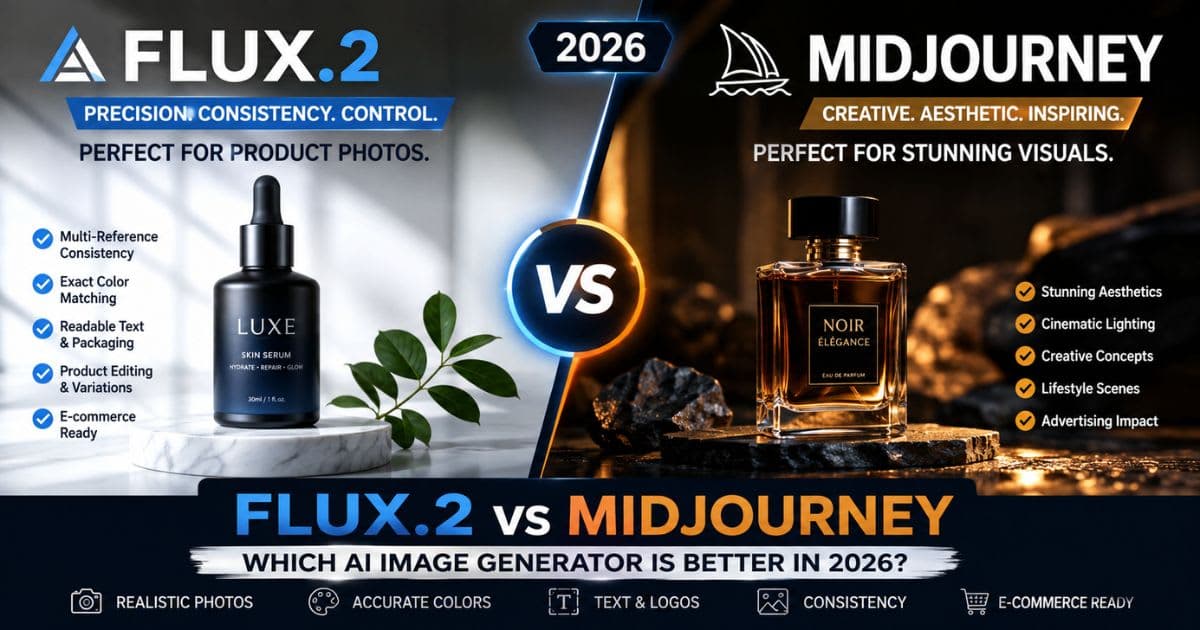
Introduction
Choosing
between FLUX.2 vs Midjourney can feel tricky when both models
create impressive AI images. However, they take noticeably different approaches
to image generation. FLUX.2 focuses on photorealism, precise
control, reference images, and production-ready workflows. Midjourney stands
out for artistic quality, creative interpretation, and visually striking
results.
For product
photography, advertising, and commercial projects, these differences can
directly affect your workflow and final results. This AI image
generator comparison looks at image quality, prompt accuracy, editing,
references, speed, pricing, and practical use cases. By the end, you’ll know
which model fits your creative goals, budget, and workflow best.
FLUX.2 vs Midjourney: Quick Comparison
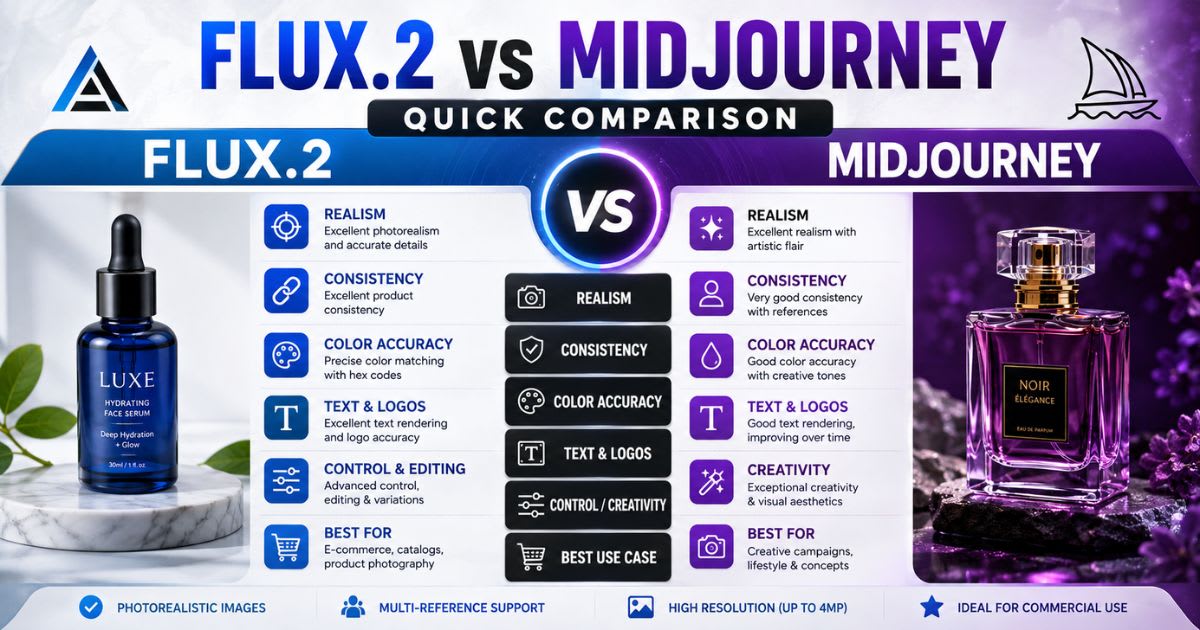
The
fastest answer is simple: FLUX.2 vs Midjourney comes down to control
versus polish for most sellers. FLUX.2 offers stronger control for demanding
product photography, multi-reference workflows, and precise color control.
Midjourney remains excellent for aesthetic quality and an intuitive creative
experience.
|
Feature |
FLUX.2 |
Midjourney |
|
Photorealism |
Excellent |
Excellent |
|
Product consistency |
Excellent |
Very good |
|
Reference images |
Strong multi-reference support |
Strong reference features |
|
Color control |
Precise |
More artistic |
|
Text rendering |
Strong |
Improved significantly |
|
Artistic style |
Strong |
Excellent |
|
API workflow |
Available |
Primarily platform-based |
|
Pricing model |
Usage-based |
Subscription |
For an e-commerce seller, the better choice depends entirely on your actual goal today. FLUX.2 fits when product accuracy matters most for catalog work. Midjourney fits when you want lifestyle scenes, campaigns, or polished creative concepts instead.
FLUX.2 vs Midjourney: What Changed in 2026?
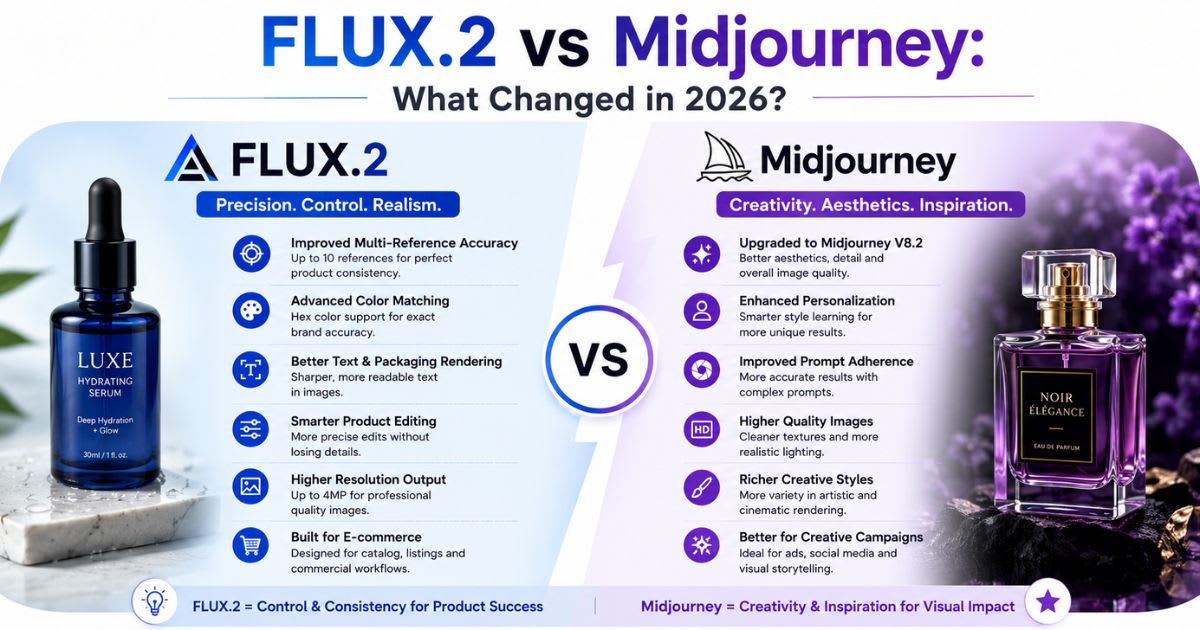
The FLUX.2 vs Midjourney
comparison looks different now. Both model families moved forward significantly
this year. FLUX.2 is Black Forest Labs' latest generation. It comes with Pro,
Max, Flex, and Klein variants. Each variant is built for a different workload.
Midjourney also progressed. V8.2 became its default in July 2026.
What
FLUX.2 Changed for Product Photography
FLUX.2 gives product creators
more practical control. Its current models support reference images
and high-resolution generation. They also offer color control
and prompt-driven editing. The Pro model targets production workflows. It does
this through the official API workflow for teams.
What
Midjourney Improved for Product Images

Midjourney improved prompt
comprehension this year. It also improved generation speed noticeably. V8.1
introduced faster rendering. It also handled detailed prompts better. V8.2 then
became the default version. It added aesthetic and personalization
upgrades. These upgrades raised image quality well above older
versions.
Image
Quality: Photorealism, Detail, and Artistic Style
Customers judge realism the
moment they see a product image. In the FLUX.2 vs Midjourney
photorealism test, FLUX.2 wins on precision. It produces convincing surfaces
and natural lighting. It also delivers controlled compositions every time. That
precision matters when a scene must look like a real photograph, not obvious AI
art. Midjourney takes a different creative route. It aims for the same realism
goal differently. Its artistic style can look strikingly
polished. It often adds attractive lighting automatically. That helps lifestyle
campaigns look good fast. But strong stylization can shift a product's exact
visual identity.
Which
Produces More Photorealistic Product Photos?
For strict product replication,
FLUX.2 wins clearly. Its production models emphasize deliberate generation.
They also use structured reference images across scenes.
Midjourney can still produce beautiful results. But its stylization may reshape
small product details.
Material,
Texture, Lighting, and Surface Detail
Product photography exposes weak
models fast. Surface detail reveals problems almost instantly.
Glass needs believable reflections. Leather needs visible grain. Metal needs
controlled highlights and shadow. FLUX.2 handles these
physical cues well. Midjourney often adds stronger cinematic polish instead.
Realistic
Product Shots vs Artistic Product Images
Think of it like a photographer
versus an art director. FLUX.2 follows the brief closely every
time. It sticks to instructions literally. Midjourney interprets the brief
creatively instead. That makes it better for campaign concepts. But it's less
reliable for strict catalog accuracy.
Prompt
Understanding and Creative Control
A strong product prompt controls more than just the object. In this FLUX.2 vs Midjourney round, both models need clear instructions. They need lens, angle, background, and color palette details. Strong prompt understanding matters here. A beautiful image still fails if the product changes shape. FLUX.2 emphasizes literal accuracy. It uses precise color control across its current family. Midjourney has also improved prompt obedience this year. But its artistic character remains more pronounced. That helps advertising work. It complicates strict replication work, though.
Which
Handles Product Photography Prompts Better?
FLUX.2 gets the edge with technical prompts. You can describe lighting, materials, and colors in one workflow. You can add composition and references too. Midjourney remains easier for simple briefs. It works well for a broad, unstructured premium campaign look.
Can FLUX.2
and Midjourney Follow Exact Brand Instructions?
FLUX.2 holds a clear advantage
here. Brands need precise, repeatable visual rules. Black Forest Labs
highlights exact hex colors in its documentation. It also
promises reliable text rendering. That consistency matters
when images must match brand assets exactly.
Reference
Images, Character Consistency, and Editing
Reference control is where this FLUX.2
vs Midjourney test gets practical fast. Reference workflows can
transform everyday AI product photography completely for online sellers.
Instead of describing every detail manually, you supply an existing photograph
and build the scene around it. FLUX.2 supports multi-reference images,
giving teams stronger control over every visual input used.
Consistency matters just as much across a full catalog of products. If you sell
the same sneaker across ten scenes, customers should recognize it instantly
every time. FLUX.2 supports strong reference-driven workflows,
and Midjourney also offers reference features worth testing carefully.
Which
Handles Product Reference Images Better?
FLUX.2 holds a strong advantage
for structured reference images across a full workflow.
Current documentation describes reference support across models, with Pro and
Max supporting multiple reference inputs. That flexibility
helps combine identity, lighting, and composition more
deliberately.
Keeping
the Same Product Consistent Across Images
Consistency becomes critical the
moment you build an entire catalog together. A product should never gain a
different handle, logo, sole, or silhouette unexpectedly. Reference-driven
generation and strong character consistency
principles both reduce these unwanted, distracting changes across scenes.
Product
Image Editing and Background Changes
Editing saves enormous
production time across a growing product catalog today. FLUX tools include
erasing objects, extending canvases, and virtual try-on
workflows for teams. This makes AI image editing genuinely
useful for building campaign variations quickly.
Speed,
Ease of Use, and Workflow
Speed matters once your store
contains hundreds of individual products to manage. In the FLUX.2 vs
Midjourney workflow test, FLUX.2 Pro targets production loads
directly. Black Forest Labs says it can generate images in under ten seconds
consistently. Midjourney also became faster through its newer, more efficient
releases this year. The bigger difference remains workflow philosophy
rather than raw speed alone between them. Midjourney feels like a finished app;
FLUX.2 feels like an image engine powering other systems.
Which
Generates Product Images Faster?
Both tools generate fast enough
for normal, everyday creative work sessions. FLUX.2 holds the advantage once
you build an automated image pipeline for scale. Midjourney
works well when a designer generates and reviews images interactively
instead of automatically.
Which Works Better for Automated E-Commerce Workflows?
FLUX.2 has a clear advantage
here. It's built for any API-driven workflow. Black Forest
Labs provides an official API. Developers can access FLUX.2 generation
directly through it. Teams can connect image generation to catalogs. They can
also link it to internal tools. Or they can build automated content systems
around it.
FLUX.2 vs
Midjourney Pricing and Cost per Image
Pricing changes the equation
fast. This matters for growing online stores. In the FLUX.2 vs
Midjourney pricing test, the two models differ sharply. FLUX.2 uses usage-based
billing. Midjourney uses monthly subscriptions instead. FLUX.2 Pro
starts near $0.03 per megapixel. Max reaches roughly $0.07 per megapixel.
|
Monthly usage |
Better pricing model |
Why |
|
Occasional testing |
Midjourney Basic |
Predictable monthly entry price |
|
Moderate API use |
FLUX.2 |
Pay for actual generation |
|
Large catalog production |
FLUX.2 |
Usage scales with generated
output |
|
Heavy subscription use |
Midjourney |
Relax generations reduce marginal
cost |
|
Automated workflows |
FLUX.2 |
Official API supports integration |
Midjourney currently lists Basic at $10 monthly, Standard at $30, Pro at $60, and Mega at $120. This means the cheaper option depends heavily on your actual monthly generation volume and workflow style.
Which Is
Cheaper for Small E-Commerce Stores?
For a small seller, Midjourney
often wins on price. It has a predictable monthly entry point. FLUX.2 becomes
attractive in a different case. It suits programmatic generation
or occasional high-quality images. Current FLUX 2 pricing
suits teams avoiding recurring software subscriptions.
Which Is
More Cost-Effective at Scale?
High-volume businesses should
calculate real generation costs. Sticker prices alone don't tell the full
story. FLUX.2 uses per-image API pricing. It scales directly
with megapixels generated. Midjourney becomes economical too.
This happens once you use its subscription allowances heavily every month.
Open vs
Closed Models: What Does It Mean for You?
Licensing is the quieter half of
this decision for developers. The difference between open and closed models
affects real businesses directly. In this licensing comparison,
FLUX.2 stands apart. Its open weights allow licensed
self-hosting. They also allow customization options for teams. Midjourney works
differently. It operates as a fully closed model. It has no
weight-level access. That closed simplicity has a benefit, though. It avoids
infrastructure management for smaller creative teams. But developers needing
deep customization may want more. They may prefer an ecosystem supporting
licensing and deployment. Fine-tuning work also matters here.
Always confirm current terms before building a production system.
Is FLUX.2
Open Source?
Not every FLUX.2 model shares
the same license. FLUX.2 Dev supports local deployment under applicable terms. Commercial
licensing provides broader rights instead. Always check the current open-source
license before any commercial deployment begins.
What Does
Midjourney's Closed Model Mean?
A closed model reduces technical
complexity. This helps everyday creative teams significantly. You simply use
the service. You don't manage model files or GPUs. You also skip deployment
infrastructure work entirely. The trade-off is less control over
internals. A licensed open-weight approach offers more of that
control.
Which
Gives Businesses More Control?
FLUX.2 has the stronger control story for technical teams. Current licensing options include fine-tuning rights. They also include LoRA ecosystem rights under specific tiers. Local deployment can help too. It supports businesses needing greater infrastructure control over data.
FLUX.2 vs Midjourney: Which One Is Better for Different Use Cases?
There is no single universal winner here. Product photography covers many different jobs. A catalog photo needs accuracy. A campaign needs atmosphere instead. An automated catalog needs APIs working together. The right FLUX.2 vs Midjourney choice depends on one thing: which problem you solve most often.
E-Commerce Product Photography
For Shopify stores and marketplaces, FLUX.2 usually remains the stronger practical option. Its mix of photorealistic images, reference workflows, and controlled generation fits commercial presentation well. You can focus on product accuracy instead of merely attractive scenes.
Lifestyle and Luxury Product Photography
Lifestyle work stays closer between both models in practice. Midjourney creates highly polished environments with strong aesthetic quality throughout the scene. Watches and jewelry favor FLUX.2's realism, while Midjourney adds editorial character to premium campaigns.
Product Packaging and Large Catalogs
Packaging introduces readable text as another real challenge. FLUX.2 emphasizes reliable text rendering and precise color control for branded visuals. Large catalogs benefit from FLUX.2's API and usage-based structure supporting repeatable production output.
FLUX.2 vs Midjourney — Final Verdict
For most businesses, accuracy comes first in product photography. Here, FLUX.2 vs Midjourney favors FLUX.2 overall. Its feature set combines several strengths. It offers high-resolution output and reference support. It also gives precise colors and API access. These capabilities solve problems traditional text-to-image tools handle poorly. Midjourney remains hard to dismiss, though. It excels at creative direction and campaign work. Its visual taste can turn an ordinary concept into something memorable. It does this quickly, too. Many businesses use both models together. They don't treat FLUX.2 vs Midjourney as a single winner-takes-all contest.
Choose FLUX.2 If Product Accuracy Comes First
Choose FLUX.2 for one clear reason. Your business depends on faithful products. It also needs repeatable reference control. Commercial image generation becomes easier this way. The model supports the required technical controls. Scalable, accurate catalog production favors this model consistently.
Choose Midjourney If Visual Style Matters Most
Choose Midjourney for a different reason. Your biggest goal is visual impact, not strict accuracy. It remains compelling for several use cases. These include editorial illustration and fashion concepts. It also suits creative advertising work well. Its creative instincts can add something extra. They produce the spark a technically perfect image sometimes lacks.
Final Takeaway
The
real question is not which model creates prettier pictures overall. The better
question inside any FLUX.2 vs Midjourney decision is which model keeps
products accurate while saving time. That distinction separates a fun AI
experiment from a reliable commercial system. For e-commerce businesses, FLUX.2
is the stronger starting point when accuracy, references, and automation matter
most. Midjourney deserves a place beside it when campaign aesthetics and
creative direction matter more. Use both when your brand needs the best of each
world.
Frequently asked questions
Is FLUX 2 free to use?+
FLUX 2 is not completely free through its hosted services. Some FLUX models offer local or licensed options, depending on the model.
Which FLUX 2 is the best?+
FLUX.2 [max] is the best choice for maximum quality. FLUX.2 [pro] offers a strong balance of quality, speed, and cost.
Which is better, Midjourney or FLUX 2?+
FLUX 2 is better for product accuracy, references, editing, and control. Midjourney is stronger for artistic style and creative visuals.
Is FLUX 2 good for image editing?+
Yes. FLUX 2 works well for product edits, background changes, retexturing, and controlled modifications while preserving important visual details.
Is Midjourney good for image editing?+
Yes. Midjourney offers useful editing tools such as its Editor and Vary Region. However, its editing workflow can be less precise than FLUX for production tasks.
Which Midjourney is the best?+
Midjourney V8.2 is currently the best choice for most users. It focuses on improved image quality, aesthetics, and personalization.
Related articles
 AI Image Tools
Ideogram V4 vs Nano Banana 2 : Which AI Image Tool Renders Text Better?
Ideogram 4.0 vs Nano Banana 2: Compare text rendering, image quality, editing, pricing, and find the best AI image model.
 AI Image Tools
GPT Image 2 vs Nano Banana Pro: Top Tools Compared In 2026
GPT Image 2 vs Nano Banana Pro: Compare image quality, text accuracy, editing, pricing, and find the best AI image model.
 AI Image Tools
Nano Banana Pro vs Nano Banana 2: Which One Should You Pay For?
Nano Banana Pro vs Nano Banana 2: compare speed, quality, features & pricing to pick the best AI image model for you.
New AI tool reviews, in your inbox.
Get new reviews and comparisons in your inbox. No spam, unsubscribe anytime.
Comments (0)
Be the first to comment.