ChatGPT vs Claude vs Gemini: Which should you use?
ChatGPT vs Claude vs Gemini: compare pricing, writing, coding, and video tools to pick the right AI assistant for you.
Introduction
ChatGPT vs Claude vs Gemini all work well in
2026. The real question is not which one is smartest. It is which one fits how
you actually work.
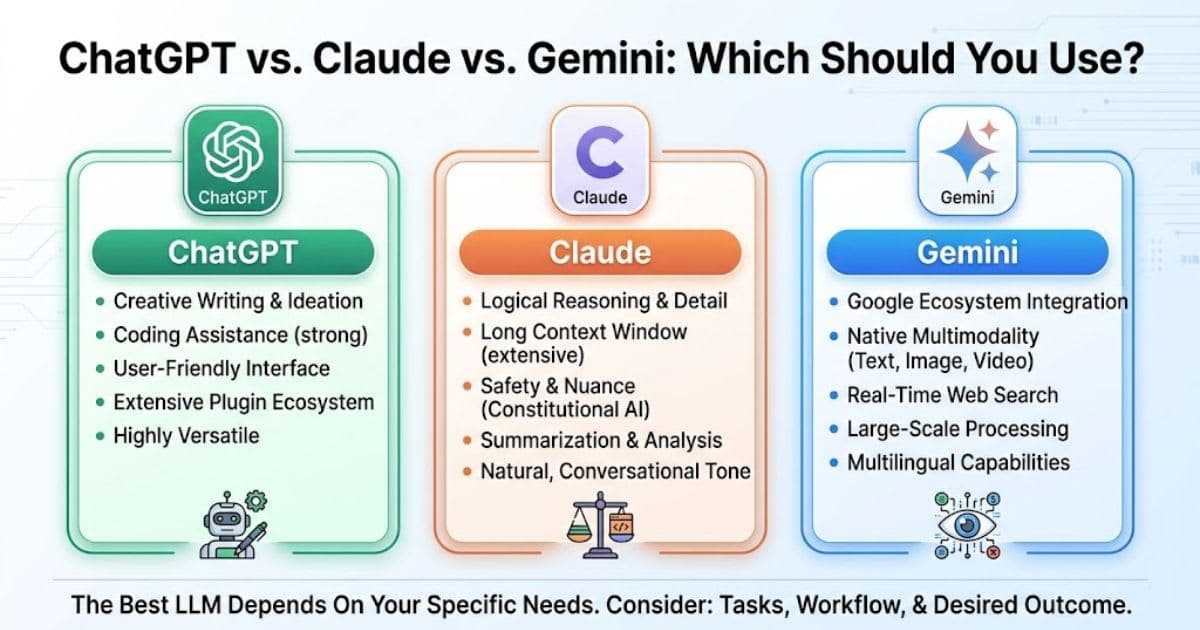
Here is the short version. ChatGPT is the widest, with the
most integrations and tools. Claude goes deepest on long, careful work like
writing and code. Gemini is the most connected, since it lives inside Gmail,
Docs, and YouTube already.
Quick Verdict: Which One Should You Pick?
Choose
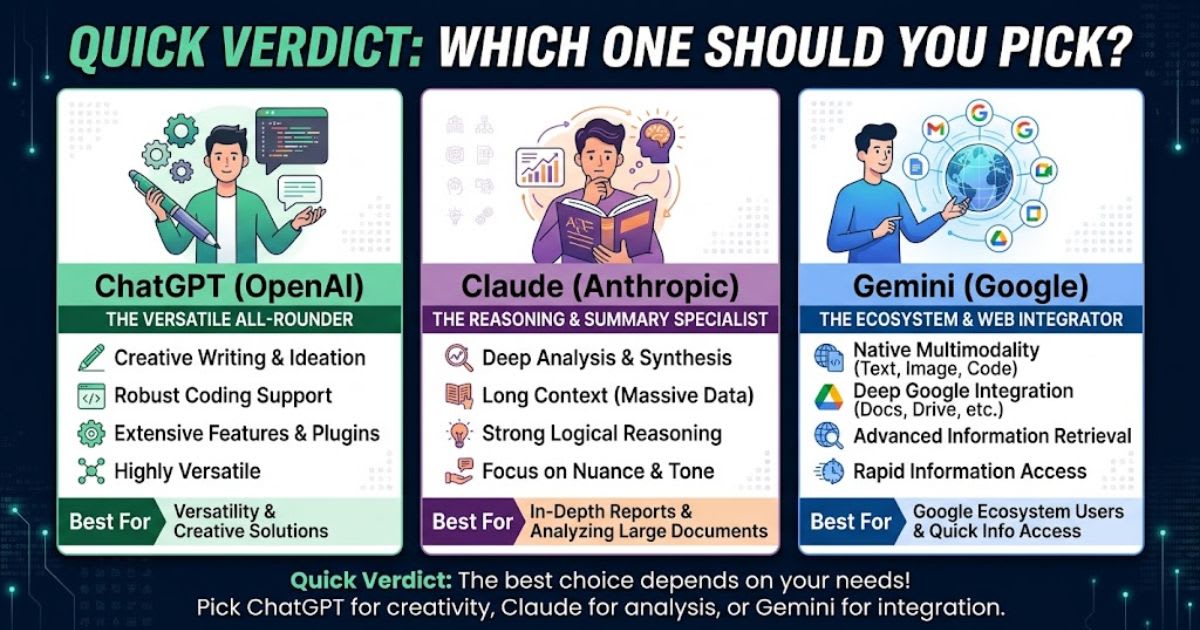
ChatGPT if you want the broadest ecosystem and a cheap way in. It is the
safest pick if you are not sure yet. Choose Claude if you write or code
for a living. It leads on long-form writing and multi-file coding work. Choose Gemini
if you live inside Google Workspace, want video tools built in, or want extra
storage bundled with your plan.
The Simple Rule of Thumb
If you can only pay for one,
ChatGPT Plus or Claude Pro at $20 a month are the two safest picks. Gemini’s
value grows once you count its bundled storage and YouTube Premium into the
price.
ChatGPT vs Claude vs Gemini: Full Comparison Table
|
Feature |
ChatGPT |
Claude |
Gemini |
|
Company |
OpenAI |
Anthropic |
Google |
|
Free
tier |
Yes,
unlimited text chat, limited uploads |
Yes,
web, mobile, desktop, memory |
Yes,
full Gemini app access |
|
Entry
paid plan |
Go,
$8/month |
Pro,
$17/month (annual) |
AI
Plus, around $5/month |
|
Mainstream
plan |
Plus,
$20/month |
Pro,
$20/month (monthly) |
AI
Pro, about $20/month |
|
Power-user
plan |
Pro,
$100 or $200/month |
Max,
$100 or $200/month |
AI
Ultra, $100 or $200/month |
|
Coding
agent |
Codex |
Claude
Code |
Google
Antigravity |
|
Video
generation |
Limited
on standard tiers |
No |
Yes,
Gemini Omni |
|
Bundled
storage |
None |
None |
5TB
to 20TB+ |
Prices
change often. Check each company’s official pricing page before you buy.
What Each Plan Actually Costs
OpenAI
runs the widest ladder of the three. Free gives you unlimited text chat on a
lighter model, plus limited uploads and images. Go, at $8 a month, raises those
limits without unlocking the flagship model. Plus, at $20 a month, is where
most people land, with the full GPT-5.6 model family and expanded tool access. Anthropic
keeps things simpler. Free covers chat on web, phone, and desktop, with memory
and file creation. Pro is $20 a month, or $17 if billed yearly, and unlocks
Claude Code and full model access. Max starts at $100 a month for heavier daily
use, with a $200 tier for the highest limits.
A Note on OpenAI’s Ads Test
OpenAI has started testing ads
on its Free and Go tiers in the US. Paid Plus and Pro plans stay ad-free. This
is worth knowing if seeing ads inside a paid-adjacent tier bothers you.
Google’s Bundled Pricing
Google bundles the most extras. AI
Pro runs about $20 a month and adds several terabytes of storage plus expanded
Gemini limits. AI Ultra starts at $100 a month for higher usage, and a $200
tier adds even more headroom, alongside a bundled YouTube Premium subscription.
Google cut prices across this tier at its May 2026 event, and added a new lower-cost
Ultra option below the old top tier. If you already pay for Google storage and
YouTube Premium separately, the Ultra tiers can work out cheaper once you add
those costs together.
Best AI for Writing
Claude
wins here, and it is not close for long-form work. Its output needs less
editing. It holds a clear voice across long pieces and pushes back when a brief
does not make sense, instead of guessing. ChatGPT is faster for short bursts:
subject lines, quick rewrites, and social posts. Its custom GPTs also make it
easy to set a house style for a team to reuse. Gemini’s writing is solid, and
its real edge is location: drafting right inside Gmail and Docs skips a
copy-paste step entirely.
Best AI for Coding

Claude
goes deep, ChatGPT goes wide, and Gemini goes fast. Claude Code handles
large, multi-file work well, like refactors and bug hunts across a full
codebase. It reads context carefully and stays cautious about risky changes. ChatGPT’s
Codex benefits from the biggest surrounding ecosystem, with more IDE plugins
and community tools. If your workflow depends on one specific plugin, ChatGPT
often has it. Gemini’s fast model, paired with Google Antigravity, suits quick
iteration loops where speed matters more than a perfect first pass.
Choosing Based on Your Coding Style
Pick Claude for big,
careful, multi-file work. Pick ChatGPT if you rely on a specific plugin or IDE
integration. Pick Gemini when speed matters more than a flawless first draft.
Best AI for Research and Reasoning
All
three now offer a deep research mode that browses the web and builds a cited
report. The real differences show up in tone. ChatGPT’s research mode covers
the widest range of sources on its higher tiers. Claude stays the most cautious,
flagging uncertainty instead of glossing over it. Gemini’s research mode,
paired with Google’s search index, is strongest on questions where fresh, broad
web coverage matters most. For anything you plan to cite publicly, run the
same question through two tools and compare.
Best AI for Images and Video
Gemini
wins this category clearly. Gemini Omni can generate and edit video from
mixed inputs like images, audio, and text, with editing that keeps characters
consistent across changes. It is available on Google’s paid tiers, with free
access through YouTube Shorts. ChatGPT holds a solid second place on still
images and voice. Claude does not really compete here. Its multimodal strength
is reading documents and screenshots, not generating new media.
Privacy and Data Handling
This is easy to miss and worth a moment of attention. Anthropic’s team plans do not train on your content by default, and Claude leans heavily on safety in how it positions its models. OpenAI offers data controls on consumer plans, with stronger contract terms on business tiers. Google’s data handling depends on which product you use. Workspace content follows different rules than a normal consumer Gemini chat. If you handle client data or anything under NDA, read the specific terms for your exact plan, not just the general privacy page.
Which One Fits You?
|
If you are… |
Use |
Typical Plan |
|
A
writer or content marketer |
Claude |
Pro,
$17-20/mo |
|
A
developer in a large codebase |
Claude |
Pro
or Max |
|
A
developer who needs speed |
ChatGPT |
Plus,
$20/mo |
|
A
student or casual user |
ChatGPT |
Free
or Go, $8/mo |
|
A
Google Workspace user |
Gemini |
AI
Pro, ~$20/mo |
|
A
video creator |
Gemini |
AI
Plus or Pro |
|
Running
a small team on a budget |
ChatGPT |
Go,
$8/mo |
The honest
advice for most people: spend a week using the free tiers of all three on your
own real tasks, not test prompts. The gap between them on benchmarks is now
smaller than the gap on fit for your specific work.
Making the Switch, or Using More Than One
You
do not have to pick just one. Many people run two: one for writing, one for
coding, or one for quick cross-checks. Switching between them costs almost
nothing, since the free tiers make testing cheap. A useful habit is running the
same real task, like drafting an email or debugging one function, through two
tools and seeing which answer you would actually use. Within a week, you will
know which tool earns a permanent spot in your day.
Common Mistakes When Switching
Do not judge a tool from one single prompt. Every model has different strengths, and the one that fails your first question might win your tenth. Also, do not assume the most expensive plan is automatically best. For daily work, free and mid tiers are often just as good as the premium ones.
The Bottom Line
ChatGPT started this category, but real competition has
made choosing genuinely useful. Claude stands out for careful writing and code.
Gemini wins on scale and Google integration. ChatGPT wins on breadth and
ecosystem size. The smartest move is not picking one winner forever. Try the
free tier of all three this week on your real work, and keep whichever one
removes the most friction from your day. Prices and model names here reflect
information verified in 2026 and change often, so confirm current details on
each provider’s official pricing page before you subscribe.
Frequently asked questions
Is Claude Better Than ChatGPT?+
For long writing and multi-file coding, most users find Claude needs less editing. For wider integrations and image tools, ChatGPT leads. Neither wins every case; it depends on whether you value depth or breadth.
Is Gemini Free to Use?+
Yes. Google offers a real free Gemini tier. Paid plans start around $20 a month for AI Pro and run up to $200 a month for the top AI Ultra tier, each bundling Google storage.
Which AI Is Best for Coding?+
Claude Code tends to lead on large, multi-file work. ChatGPT’s Codex has the widest plugin and IDE support. Gemini’s fast model is the quickest for rapid iteration. Your best pick depends on whether correctness, tooling, or speed matters most to you.
Can I Use More Than One AI Assistant?+
Yes, and many people do. A common setup is one paid subscription plus a free tier of another tool, used for cross-checking facts or comparing answers on important tasks.
Do These AI Tools Show Ads?+
OpenAI is testing ads on ChatGPT’s Free and Go tiers in the US. Its paid Plus and Pro tiers stay ad-free. Claude and Gemini do not currently show ads on their consumer plans.
Related articles
 Comparisons
Best AI SEO Tools in 2026: What Each One Really Costs
Compare the 10 best AI SEO tools in 2026 — Semrush, Ahrefs, Surfer, and more. See pricing, features, and AEO visibility.
 Comparisons
GitHub Copilot vs Cursor: Which AI Coder Wins in 2026?
GitHub Copilot vs Cursor compared for 2026 — pricing, agents, and IDE support. Find the AI coding assistant that fits your workflow.
 Comparisons
ChatGPT vs Gemini (2026): Which AI Should You Buy?
ChatGPT vs Gemini (2026): compare pricing, coding tools, context size, and video features to find your best AI fit.
New AI tool reviews, in your inbox.
Get new reviews and comparisons in your inbox. No spam, unsubscribe anytime.
Comments (0)
Be the first to comment.