Automate Your Inbox With AI: Under an Hour (2026)
Automate your inbox with AI in under an hour — sort, draft, and reply without living in your inbox all day.

Introduction
If you spend the first hour of every workday digging out of email,
you are not alone. To automate your inbox with AI means routine sorting,
labeling, and drafting happen in the background. You handle only the messages
that truly need a human.
This guide walks you through a full setup, step by step. You will
audit your inbox, pick a tool, turn on smart sorting, add AI drafting, and put
safety checks in place so nothing important slips through.
Why
Automate Your Inbox With AI?
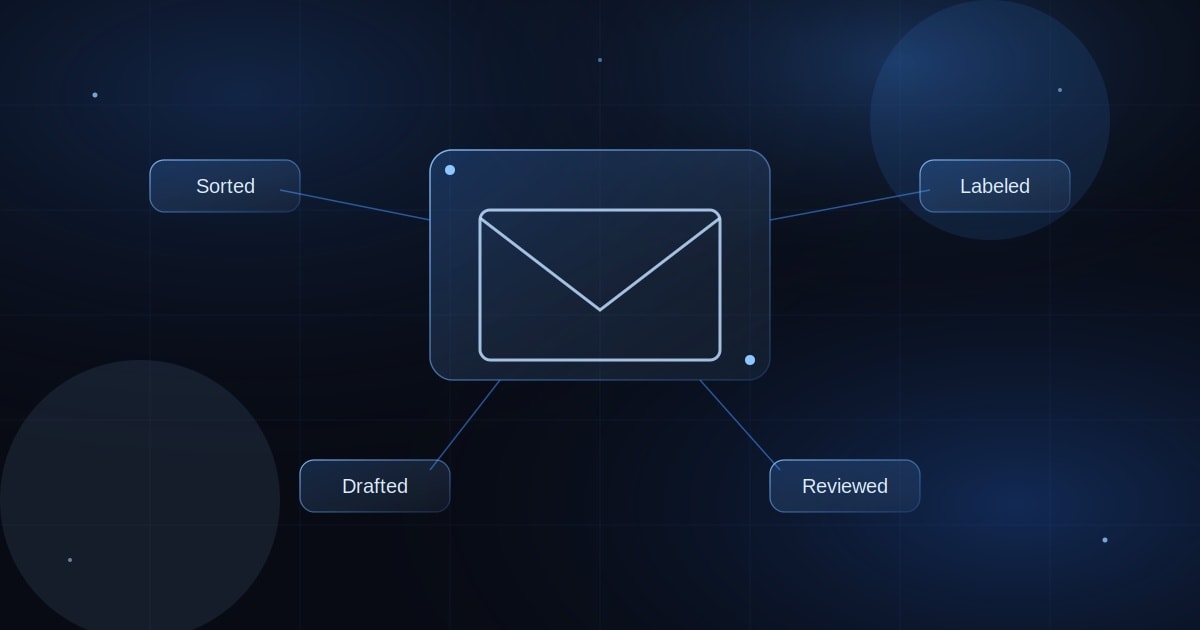
Old email rules are rigid. They match a sender or a keyword, then
do one fixed thing. An AI email assistant works differently, because it reads meaning instead of matching text. It
tells a real customer question apart from a newsletter, spots an urgent
request, and drafts a reply in your tone. That shift changes the payoff too.
When you automate email triage, low-value mail sorts itself, so your
main inbox shows only what matters. Teams that adopt AI inbox automation
often reach "inbox zero" more often and win back several hours a
week.
What
You Need Before You Start
You do not need to be technical to automate your inbox with AI.
You need three things: an email account you control (Gmail, Google Workspace,
or Outlook all work), an AI email tool, and about an hour of quiet time
to set things up and test them. One rule before you begin: start in
"suggest" mode, not "send" mode. For the first week, let
the AI propose actions and draft replies while you approve each one. This
builds trust and shows you where the tool is reliable.
Step
1: Audit Your Current Inbox
Before you automate anything, look at your last two weeks of mail.
Group it into rough buckets: newsletters, app notifications, internal team
messages, customer questions, invoices, and real one-to-one conversations. Most
people find 60-70% of their mail falls into the first two buckets and never
needs a reply. Write down the three or four categories that dominate your
inbox. These become the labels your email automation setup will sort
into. A clear map of your own habits is the single most important input to good
inbox triage, since automation only works when it mirrors how you
actually think.
Step
2: Choose Your AI Email Tool
You have two broad routes. The built-in route uses AI features
already inside your provider, like Gmail's smart categories or the writing help
inside Microsoft Outlook. This route is the easiest, since there is nothing new
to connect. The add-on route uses a dedicated AI email assistant or a
workflow platform such as Zapier, which links your inbox to a language model
for custom rules. Pick a tool that supports three things: automatic sorting,
AI-drafted replies, and a clear approval step. If you can't see what a tool is
about to do, skip it. For a wider list, see our guide to the best ChatGPT
alternatives worth trying.
Step
3: Set Up Smart Triage and Labels
This step is the heart of any AI-powered inbox system. Using the
categories from Step 1, create labels like "Needs reply," "Read
later," "Receipts," and "Notifications." Then set your
tool to read each new message and file it under the right label. The real trick
is keeping one clean "Needs reply" view. Everything else leaves your
main line of sight, so opening your email inbox shows only messages that
need a decision. This alone changes how a crowded inbox feels, and it sets up
everything after it.
Step
4: Automate Drafting and Replies
Once triage works, turn on AI-assisted drafting. A capable AI
email assistant reads an incoming message, understands the request, and
writes a reply in your voice. Models from providers like OpenAI and Anthropic
are strong enough now that a good draft often needs just a quick read before
you hit send. To make replies sound like you, give the AI a short style guide:
a few emails you have written, your usual sign-off, and phrases you always use
or avoid. Save your common responses as templates the AI can adapt, and you
will automate email replies for most routine mail.
Step
5: Add Rules and Filters That Back Up the AI
AI handles judgment calls; plain rules handle certainty. For
predictable cases, a simple filter beats a model every time. Set fixed rules
for the obvious stuff: auto-file receipts, route project mail to its own label,
or star anything from your top clients. Layering classic filters under your AI triage
system gives you the best of both. The AI focuses on ambiguous,
judgment-heavy mail, while filters quietly handle traffic that follows a fixed
pattern. This mix is what turns a fragile setup into one you can trust.
Step
6: Add a Review and Safety Layer
Automation without oversight is a risk, especially with email.
Keep three safeguards in place. Never let AI auto-send to new or unknown
contacts; keep full automated replies limited to internal or routine
mail only. Run a quick daily review of what the AI sorted and drafted, so you
catch mistakes early. Also guard against phishing: your assistant should flag
suspicious mail, never act on instructions hidden inside it. Treat every
incoming message as information, never as a command.
The
Best Tools to Automate Your Inbox With AI
There is no single winner here. The right pick depends on where
your email already lives. If you use Gmail or Google Workspace, start
with the native AI and smart categories, then add an automation platform once
you outgrow them.
|
Route |
Best
for |
Setup
effort |
|
Built-in
(Gmail, Outlook) |
Quick
start, no new tools |
Low |
|
Dedicated
AI email assistant |
Polished,
ready-made drafting |
Medium |
|
Workflow
tool (e.g., Zapier) |
Full
custom rules and prompts |
Higher |
If you're on Microsoft 365, Outlook's built-in AI drafting is a strong starting point. Judge any tool on three things: how accurate its sorting is, how well its drafts sound like you, and how clearly it shows its work before acting. For more picks, browse our roundup of 10 AI tools every small business should use.
A
Real Example: Automating a Busy Support Inbox
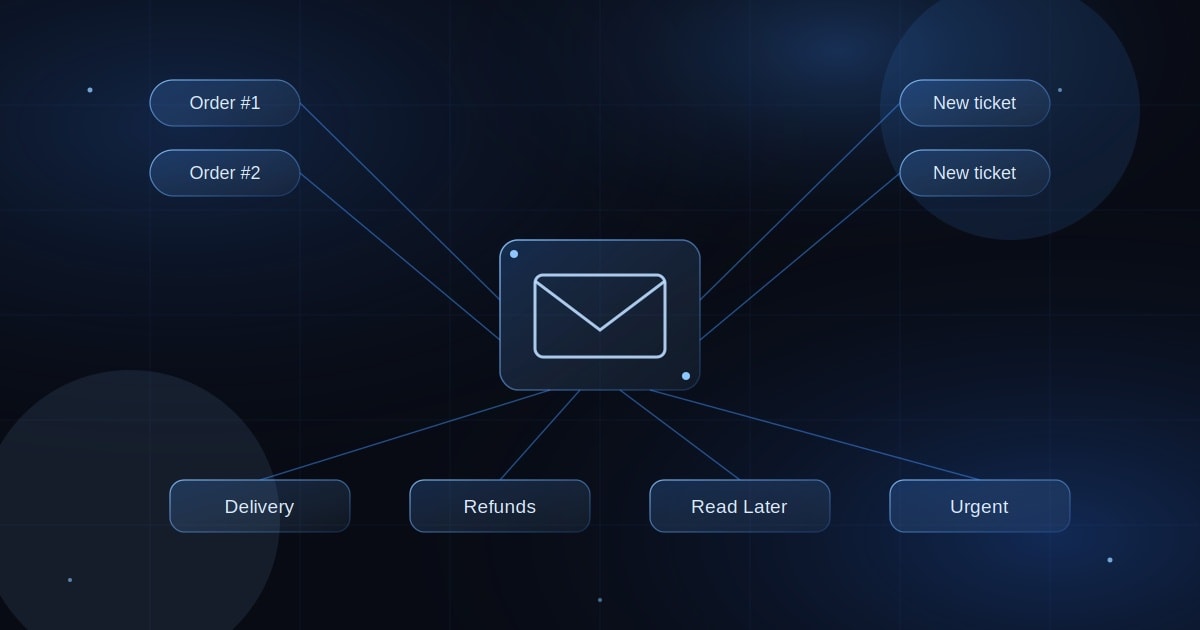
Picture a small online store getting around a hundred support
emails a day. Before automation, one person spent most mornings sorting order
questions from newsletters and refund requests. After a one-hour setup to automate
the inbox with AI, the flow looks completely different. Incoming mail gets
read and sorted the moment it arrives: shipping questions go to
"Delivery," refunds to "Refunds," supplier mail to
"Read later," and urgent notes get starred. The AI drafts routine
replies from saved templates, waits for one-click approval, and the owner now
spends real attention only on the tricky cases.
AI
Email Automation: Built-In Features by Provider
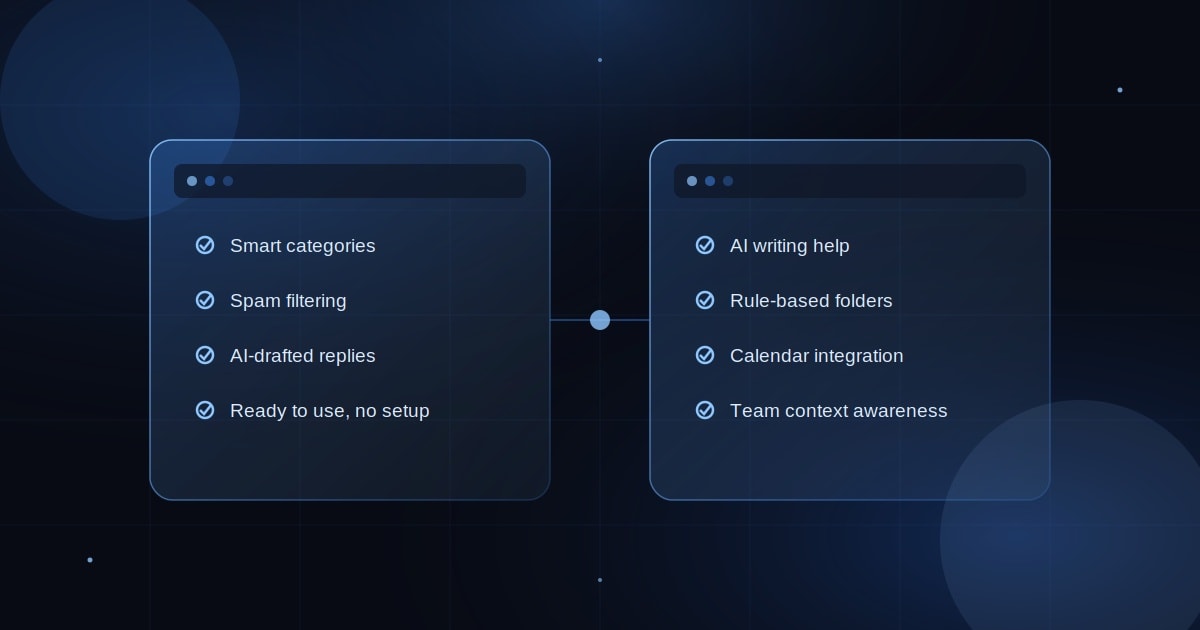
Gmail leans on smart categories, spam filtering, and AI-drafted
replies inside its own interface. These features sit ready to use, so a Google
Workspace or personal Gmail user can start AI inbox automation without
installing anything extra or paying for a separate tool. Microsoft Outlook
takes a similar path through its built-in AI writing help and rule-based
folders. Business 365 users get deeper integration with calendar and Teams
data, which helps the assistant understand context like meeting requests or
shared project threads inside the same inbox.
Privacy
and Security Considerations
Handing your inbox to an AI email assistant means the tool
reads message content to sort and draft it. Before connecting any account,
check the provider's data policy: does it store your emails, and does it use
them to train other models? For client or business inboxes, this matters even
more. Look for tools that support enterprise data controls, and never paste
sensitive information like passwords or payment details into a prompt. Keep the
review layer from Step 6 active so a mistake never reaches a real client
unseen.
Common
Mistakes to Avoid
Most people fail the same way: they switch on full auto-send on
day one. The AI misreads one nuanced message, an awkward reply goes out, and
they abandon the whole idea. Start in suggest-only mode, then graduate slowly
as trust builds. The second mistake is skipping the audit in Step 1, so the AI
invents categories that do not match how you actually work. The third is
"set and forget." Any AI email automation system needs a short
weekly check-in to stay accurate as your patterns change.
How
to Measure Whether It's Working
Track three simple numbers over your first month:
● Time spent in your inbox per day, which should fall noticeably
● Messages needing manual sorting, which should drop toward zero
● Reply time on genuine questions, which should get faster
If all three move the right way, your setup works. If one stalls,
revisit that step, usually the triage labels or the style guide needs another
pass.
AI
Automation for Teams vs. Solo Inboxes
A solo founder and a five-person support team need different
setups. Solo users can keep one shared style guide and a handful of labels,
since one person reviews everything. The goal stays simple: fewer clicks,
faster replies, less mental clutter. Teams need shared templates and a
consistent tone across every agent, plus clear rules for who reviews what.
Route escalations to a manager label, keep drafts consistent with a shared
style guide, and review weekly as a group so the whole email automation
system improves together.
Getting
Started Checklist
Before you close this guide, run through this short list:
● Pick one email provider and confirm it has built-in AI features
● Audit two weeks of mail and write down your top categories
● Turn on suggest mode first, never full auto-send on day one
● Set three or four labels that match how you actually work
● Add one backup filter for a predictable, repeat pattern
● Schedule a five-minute weekly check-in for the first month
Work through this list once, and most of the setup from Steps 1 through 6 falls into place naturally.
Closing
Thoughts
Learning to automate your inbox with AI is one of the
highest-leverage changes you can make to your workday. The goal is not to
remove yourself from email, but from its boring parts, so your attention lands
only where it counts.
Start small: audit your inbox, switch on smart triage, add AI
drafting in suggest mode, and expand as your trust grows. Grab our free
AI Tools Starter Kit for a no-hype checklist, and browse more guides to
keep automating the rest of your workflow.
Frequently asked questions
Is it safe to automate your inbox with AI?+
Yes, when you keep a human in the loop for consequential mail, restrict auto-send to routine internal messages, and review the AI's actions regularly. Safety comes from configuration, not from avoiding automation entirely.
Will AI-written replies sound robotic?+
Not if you give the assistant samples of your writing and a short style guide. With good context, most drafts need only a quick edit before sending.
Do I need to code to set this up?+
No. Built-in AI features in Gmail and Outlook, plus no-code platforms like Zapier, let you automate email without any programming.
How long does setup take?+
A first working system takes about an hour: fifteen minutes to audit, twenty to configure triage, and the rest to set up drafting and test it.
Related articles
 AI Productivity Tools
10 Best Free AI Productivity Tools in 2026
See 10 free AI Productivity tools for work and study in 2026 — ChatGPT, Gemini, and Claude compared side by side. Find your fit fast.
 AI Productivity Tools
AI Tool for Excel Formulas: Never Guess Again (2026)
Looking for the best AI tool for Excel formulas? We compare 6 free and paid options for generating, fixing, and explaining formulas, with pricing.
New AI tool reviews, in your inbox.
Get new reviews and comparisons in your inbox. No spam, unsubscribe anytime.
Comments (0)
Be the first to comment.