10 Best AI Tools for Small Business Accounting in 2026
Discover the best AI tools for small business accounting in 2026 — automate bookkeeping, cut errors, boost cash flow. See the full rankings now.
Introduction
Running your books shouldn't feel
like a second job, yet most founders spend hours buried in receipts instead of
building their business. AI tools for small business accounting
fix this by automating data entry, spotting errors before they cost you money,
and turning raw numbers into insights you can actually act on. This guide
breaks down the ten best platforms of 2026, from QuickBooks and Xero to
specialized picks like Ramp and Vic.ai, so you can match the right tool to your
stage of growth. You'll learn how machine learning improves transaction
categorization, why real-time reporting beats
month-end surprises, and what separates genuine automated bookkeeping
from basic rule-based software. By the end, you'll know exactly which tool fits
your budget and workflow.
What Are AI Tools for Small Business Accounting? (A 2026 Definition)
AI tools for small
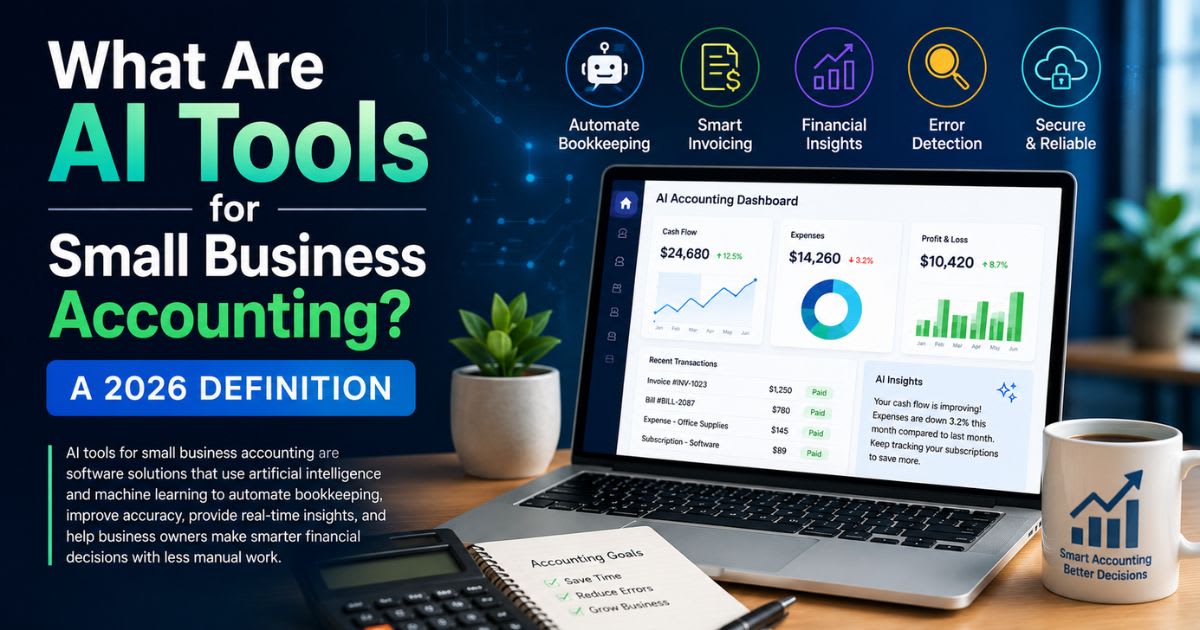
business accounting do far more than store numbers in a digital ledger
for record-keeping purposes. They use advanced machine learning
algorithms to actively interpret your financial data and understand complex
business context. This technology distinguishes between a client lunch and a
team dinner without you lifting a finger to correct it. By leveraging natural
language processing, these systems turn complex financial records into
clear, actionable stories that help you understand your business health
instantly. The shift from reactive recording to proactive financial
forecasting is what sets 2026's AI tools for small business
accounting apart from older versions. Instead of waiting until
month-end to see where you stand, you get real-time financial insights
every single day to guide decisions. These platforms act as virtual CFOs,
providing continuous checks on your liquidity and profitability without
constant supervision. You no longer need a degree in finance to understand your
bottom line because the software translates raw data into simple, strategic
advice for your growth.
Basic Automation vs. True Artificial Intelligence
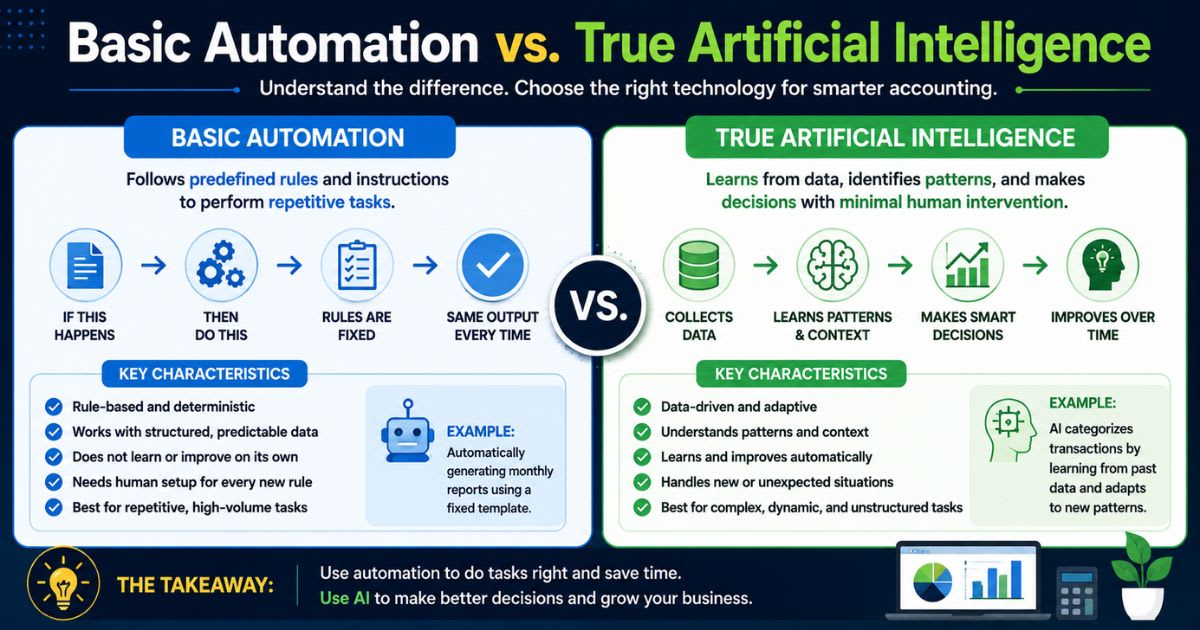
Many people confuse basic accounting automation with true artificial intelligence, but the difference is massive for your daily operations and accuracy. Traditional automation follows rigid, static rules, such as "always categorize Starbucks as meals," which often leads to errors. In contrast, true artificial intelligence accounting adapts to your unique business habits and evolving spending patterns over time. It learns from your corrections and historical data to improve its transaction categorization automatically, making it smarter with every invoice it processes.
|
|---|
Key Benefits of Using AI Tools for Small Business Accounting
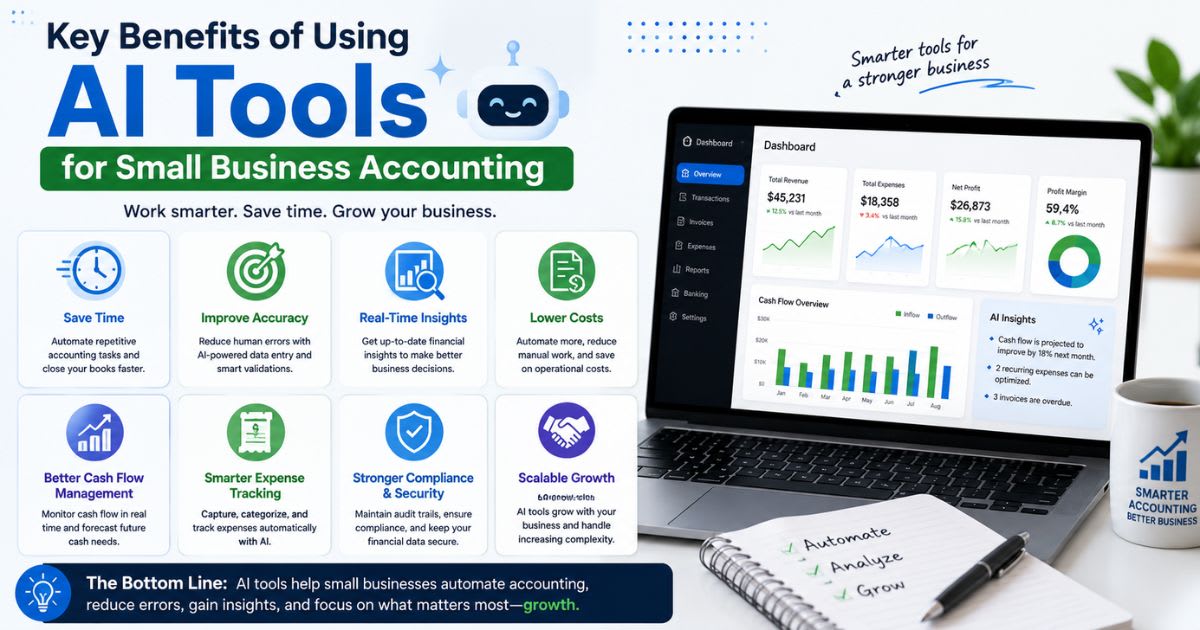
Implementing automated bookkeeping saves you countless hours every week by eliminating the drudgery of manual data entry and receipt chasing. When you remove human error from the equation, your financial records become significantly more accurate and reliable for potential investors. This workflow automation allows you and your team to redirect valuable energy toward growing your brand, developing new products, or improving customer service instead of chasing down missing receipts. Beyond saving time, these tools provide unparalleled cash flow visibility and keep you audit-ready at all times without unnecessary stress. Continuous, automated reconciliation ensures that your bank statements match your books every single day, removing the panic of month-end closes. With real-time reporting, you can spot trends immediately and make informed decisions about hiring or inventory without waiting for an accountant to send you a spreadsheet from last month.
Real-Time Insights and Strategic Decision Making
Live dashboards provide actionable financial data that empowers you to make smart choices instantly regarding your operational budget. Instead of guessing, you can see exactly which products are most profitable or which clients are paying late consistently. This level of accounting data analysis helps startup founders adjust pricing, manage inventory, and plan marketing budgets based on current reality rather than outdated historical reports.
Top 10 AI Tools for Small Business Accounting in 2026 (Categorized)
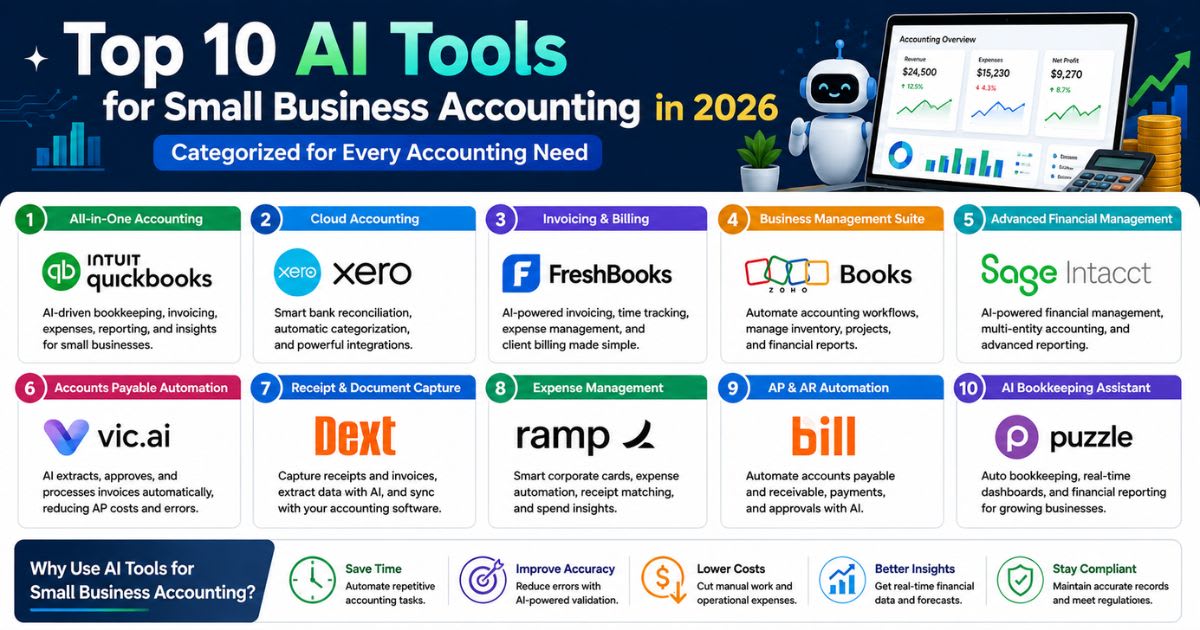
Choosing the right platform depends on your specific needs, such as expense management or deep payroll integration capabilities for your team. In 2026, the market leaders are those that offer high scalability and exceptional user experience for growing remote teams. We have categorized these top ten tools to help you find the perfect match for your startup's unique financial workflow and long-term growth stage.
| Tool Name | Best For | Key AI Feature | Official Source |
|---|---|---|---|
| QuickBooks Online | Comprehensive Bookkeeping | Intuit Intelligence for deep insights | quickbooks.intuit.com |
| Xero | Global Multi-Currency Support | Smart bank reconciliation algorithms | xero.com |
| Ramp | Expense Management | Real-time automated expense tracking | ramp.com |
| Vic.ai | Accounts Payable | Autonomous invoice processing | vic.ai |
| Zeni | Startup Financial Strategy | Full-service AI bookkeeping tools | zeni.ai |
| Docyt | Data-Driven Insights | Advanced financial statement processing | docyt.com |
| Gusto | Payroll and Tax Support | Automated tax filing and compliance | gusto.com |
| Dext | Receipt Capture | High-accuracy data extraction from docs | dext.com |
| Puzzle.io | Month-End Close | Clean financial reporting software | puzzle.io |
| BILL | AP/AR Automation | Streamlined accounts payable automation | bill.com |
Best for Comprehensive Bookkeeping and Payroll
QuickBooks Online remains a giant because its Intuit Intelligence feature provides deep financial insights directly within the dashboard for you. Xero is famous for its robust bank reconciliation capabilities and supports global businesses with seamless multi-entity accounting features for expansion. For startups that need to handle team payments, Gusto offers unparalleled payroll automation and handles complex tax filings automatically, ensuring you never miss a deadline.
Best for Automated Expense Management and AP/AR
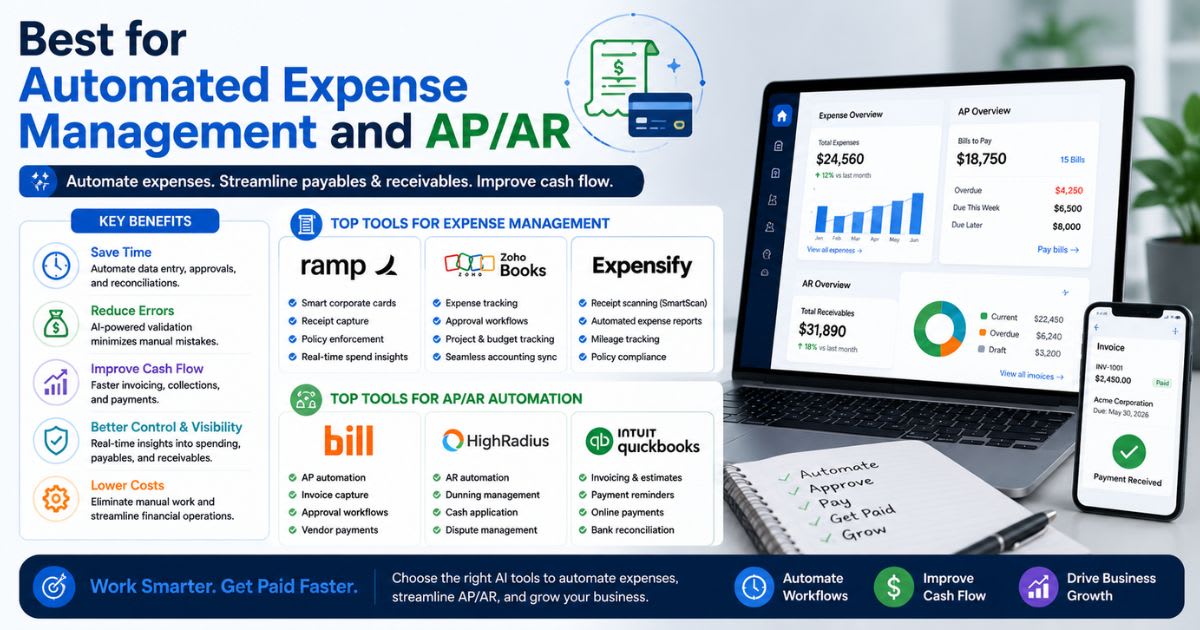
Ramp combines corporate cards with real-time expense management, giving you total control over spending before it happens unnecessarily. Vic.ai specializes in autonomous accounts payable and intelligent invoice processing, reducing approval times from days to minutes efficiently. Meanwhile, Dext excels at receipt capture and streamlined data extraction, turning messy paper trails into clean, organized digital records effortlessly for your team.
Best for Startup Financial Insights and Cash Flow
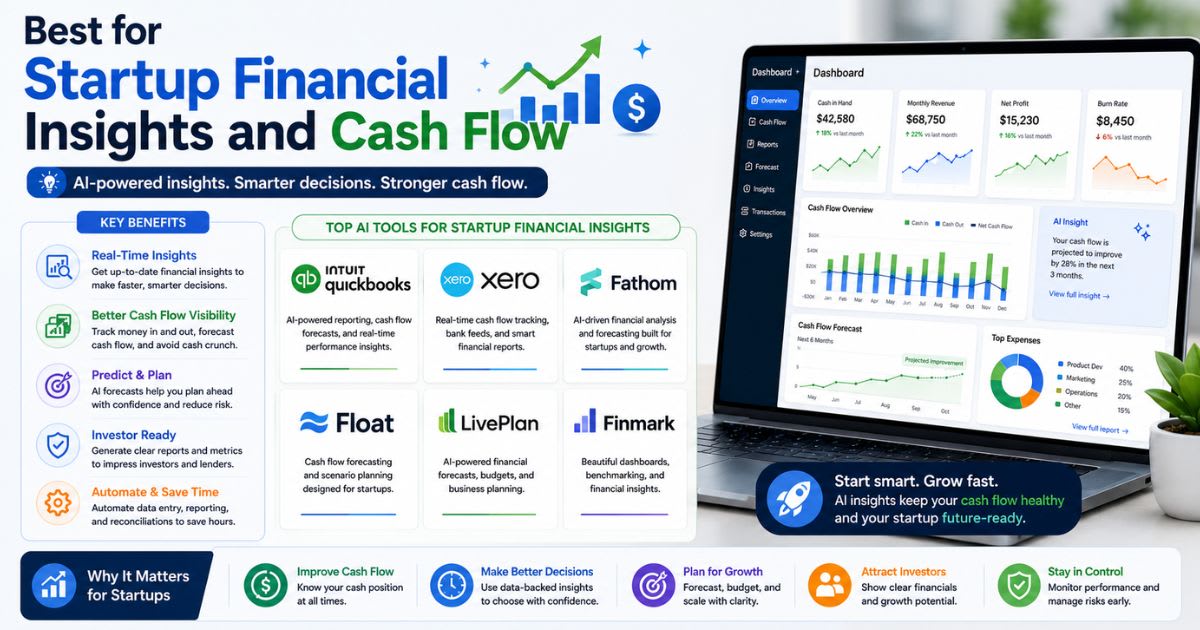
Zeni offers a unique hybrid model with full-service AI bookkeeping backed by human experts who verify the data accurately. Docyt provides deep data-driven insights and automates the entire document lifecycle for better financial data management overall. Puzzle.io focuses on simplifying the month-end close process, ensuring your financial reporting software delivers clean, investor-ready statements without the usual headache.
5 Essential Factors for Choosing the Right AI Accounting Tool
You must prioritize software integration with your existing tech stack, such as your CRM or banking APIs, for smooth daily operations. A tool that doesn't communicate with your other systems creates data silos and forces you back into manual workarounds that waste precious time. Look for platforms that offer robust accounting integrations to ensure a seamless flow of information across your entire business ecosystem and routine tasks. Equally important is scalability and transparent pricing models that fit your current budget constraints without surprises. Your chosen platform should grow with your transaction volume without hitting performance bottlenecks or surprising you with hidden fees later. As your startup expands, your cloud-based accounting software must remain fast and reliable. It also needs to handle increased complexity without requiring a costly migration to a new system.
Critical Features to Evaluate Before Signing Up
- Look for high-accuracy OCR technology for receipt scanning and automated data entry capabilities to save time.
- Ensure robust bank-level encryption and strict audit trails for maximum data security and peace of mind.
- Check for responsive customer support and comprehensive onboarding resources to help your team adapt quickly.
AI vs. Traditional Automation: How to Spot Real AI in Finance
Traditional automation follows static "if-then" rules, while true AI uses neural networks to adapt to your specific business needs dynamically. Real AI improves its accuracy over time by learning from your corrections and unique context without constant manual input from staff. If a system cannot learn from new data types or changing spending habits, it is merely a script, not an intelligent financial partner for your company. The presence of predictive capabilities is the clearest differentiator in 2026 for modern financial tools and platforms. If the software only records past events, it is basic automation without much strategic value for future planning. However, if it forecasts future cash flow trends and warns you of potential shortfalls, it is leveraging genuine predictive analytics in accounting. This forward-looking ability is what transforms a bookkeeping tool into a strategic business asset for you.
Questions to Ask Vendors About Their AI Capabilities
- Does the system use machine learning to categorize transactions dynamically without manual rules?
- Can it detect financial anomalies or potential fraud automatically through advanced pattern recognition?
- How does the AI handle unstructured data from various invoice formats and international currencies effectively?
Step-by-Step Guide to Migrating to New AI Accounting Software
Start with a thorough data audit and cleanup of your existing records before you begin the migration process carefully. Clean data ensures a smooth transition and prevents historical errors from contaminating your new AI-driven insights and reports. Taking time to organize your files now will save you weeks of troubleshooting later when the system tries to process messy legacy information from your old setup. Emphasize the importance of running parallel systems during the initial phase of adoption for safety and verification. This allows you to verify accuracy and train your team on the new interface without disrupting daily financial operations or client billing cycles. By keeping your old system active for a few weeks, you create a safety net that ensures no transactions are lost during the switch to your new platform.
Avoiding Common Migration Pitfalls
- Always create secure data backups before initiating any transfer to prevent irreversible loss of critical records.
- Map your old chart of accounts carefully to the new system structure to maintain consistency in reporting.
- Schedule migration during low-volume periods to minimize operational disruption and stress on your entire team.
Data Security and Compliance: 2026 AI Accounting Standards
Prioritize platforms with SOC 2 Type II certification and end-to-end encryption protocols for your sensitive financial data. In 2026, regulatory scrutiny is higher than ever, making robust data protection measures non-negotiable for any serious business owner. You need to know that your sensitive financial information is stored in secure, compliant environments that meet international standards for privacy and safety. Discuss compliance with evolving tax regulations and global privacy laws like GDPR with your provider carefully before signing. Ensure your chosen software updates automatically to reflect new legal requirements, keeping your startup compliant without manual intervention from your staff. This proactive approach to financial data management protects you from fines and builds trust with investors who value rigorous operational standards and transparency.
Understanding Human-in-the-Loop (HITL) Security
HITL systems combine AI speed with human oversight for sensitive financial decisions and complex entries. This hybrid approach ensures accuracy and accountability while maintaining the efficiency benefits of automated processing for routine tasks. By having a human expert review complex or unusual transactions, you get the best of both worlds: rapid automation and trusted verification for your records.
The Future of AI Accounting: Trends Beyond 2026
We are seeing the rise of generative AI plugins that allow natural language queries for financial data and instant answers. Imagine asking your software, "What were our top expenses last quarter?" and getting an instant, visualized answer without digging through menus. This conversational interface makes financial reporting software accessible to everyone in your company, not just those who know how to build complex spreadsheets. The industry is moving toward autonomous finance, where AI handles bill payments and collections independently without your input. This shift will transform accountants from data entry clerks into strategic financial advisors and business partners for your growth. As accounts receivable automation becomes standard, your team can focus entirely on building relationships and driving revenue growth instead of chasing invoices.
Emerging Technologies Shaping Financial Management
- Blockchain integration for immutable and transparent transaction records that cannot be altered by anyone.
- Advanced predictive modeling for hyper-accurate revenue forecasting and detailed budget planning for the year.
- Voice-activated commands for hands-free financial monitoring and quick status checks on the go for busy founders.
Meta Description
Discover the best AI tools for small business accounting in 2026 — automate bookkeeping, cut errors, boost cash flow. See the full rankings now.
Frequently asked questions
Is There an AI Tool for Accounting?+
Yes, AI tools for small business accounting like QuickBooks Online, Xero, and Zeni are widely available. They automate data entry, categorize transactions, and generate real-time reports.
Can CPA Be Replaced by AI?+
No, AI cannot fully replace a CPA. It handles repetitive tasks well, but complex tax strategy and audits still need human judgment.
Can I Use AI to Do My Bookkeeping?+
Yes, AI bookkeeping tools handle transaction categorization, reconciliation, and expense tracking effectively. For straightforward finances, they work well on their own.
Is CPA Still Worth It in 2026?+
Yes, CPAs still matter in 2026. AI handles routine bookkeeping, but CPAs offer strategic tax planning and regulatory expertise software can't replicate.
Is AI Going to Get Rid of Accountants?+
No, AI is reshaping accountants' roles, not eliminating them. It frees them from data entry to focus on advisory and strategic work.
Related articles
 AI for Business
AI Tools for Small Business That Pay for Themselves
AI tools for small business that pay for themselves fast — real picks for marketing, support, and accounting.
 AI for Business
Best AI Virtual Staging Tools in 2026: Real Estate Guide
Transform empty listings with AI virtual staging. Add photorealistic furniture in seconds to attract buyers and sell homes faster.
 AI for Business
GPT-6 Astra Features: Release Date, Pricing & Dashboard
Discover the powerful GPT-6 Astra features breaking records. Learn about its native multimodality, ultra-low latency, and api pricing.
New AI tool reviews, in your inbox.
Get new reviews and comparisons in your inbox. No spam, unsubscribe anytime.
Comments (0)
Be the first to comment.